Built in Pakistan, for Pakistani companies
Win the work.
Get paid.
Pay your team.
Startup-pal runs the whole company — projects, invoices, payroll and people — in one place. Priced for a Pakistani payroll, not a Silicon Valley one.
No card needed · Cancel anytime · Setup in 10 minutes
The spreadsheet stack
You already have a system. It's just made of six things that don't talk.
Rebuilt every month. One wrong row and somebody's rent is late — and you hear about it personally.
A template saved twelve times under twelve names. Nobody knows what's outstanding until cash gets tight.
Approved in a thread, remembered by nobody. Every December there's an argument about balances.
Signed at a desk, which is no use at all for the two people working from Karachi.
You'll know what the quarter actually made when the accountant tells you, some time next quarter.
Reconstructing a whole year from bank SMS and receipts, once a year, under deadline.
None of it is broken, exactly. It just costs you a day a month and the ability to answer simple questions quickly.
One connected chain
Most tools hand you one room. This is the whole house — and the corridors.
Seven separate tools means seven places the same number gets typed, and seven chances to type it wrong. Watch one job travel all the way through — or click any step.
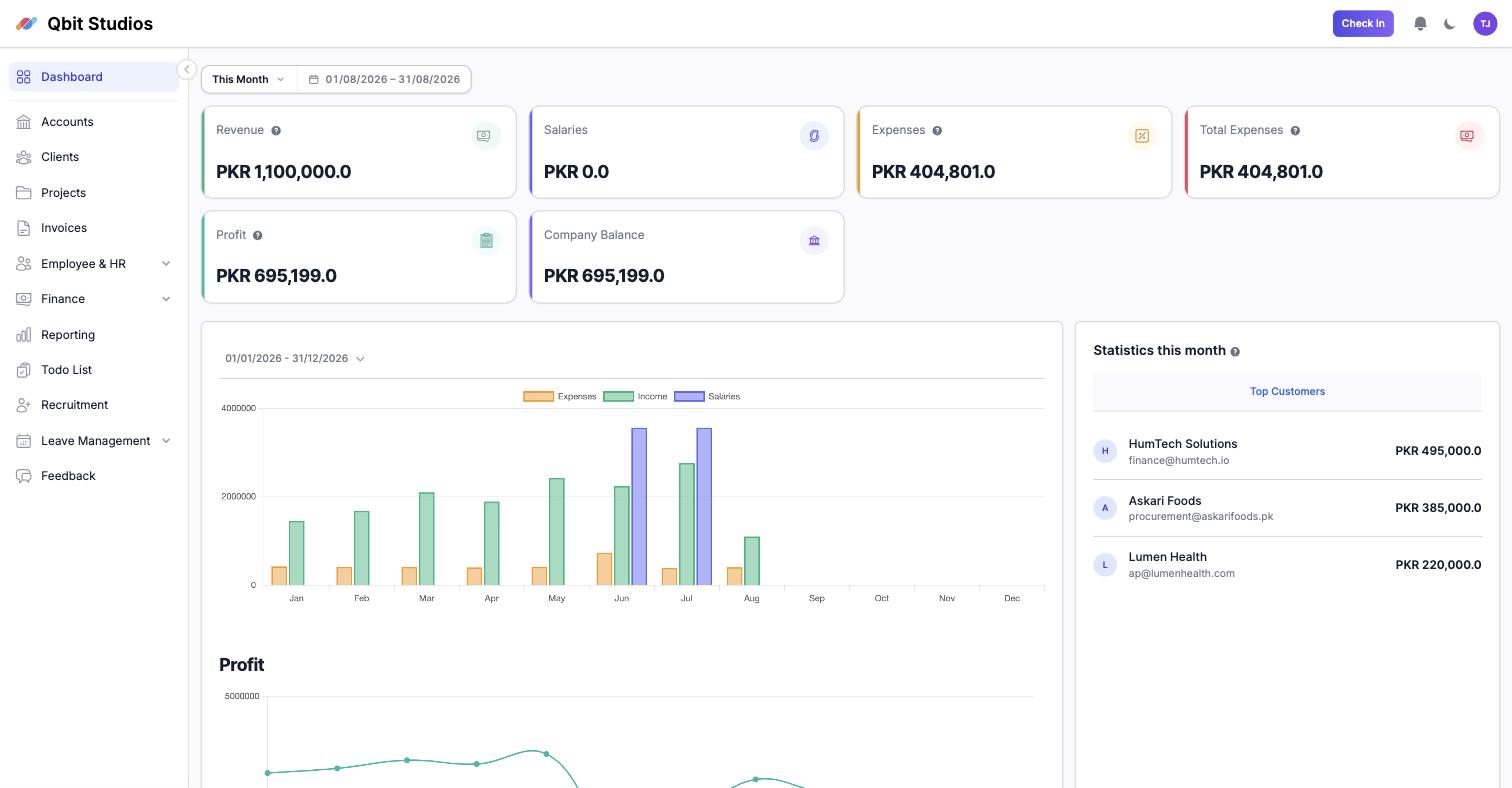
Clients
Add the client once.
Contact details, billing address, payment terms. Entered a single time, then reused everywhere below — you never retype a client name into an invoice again.
carries forward client · billing terms
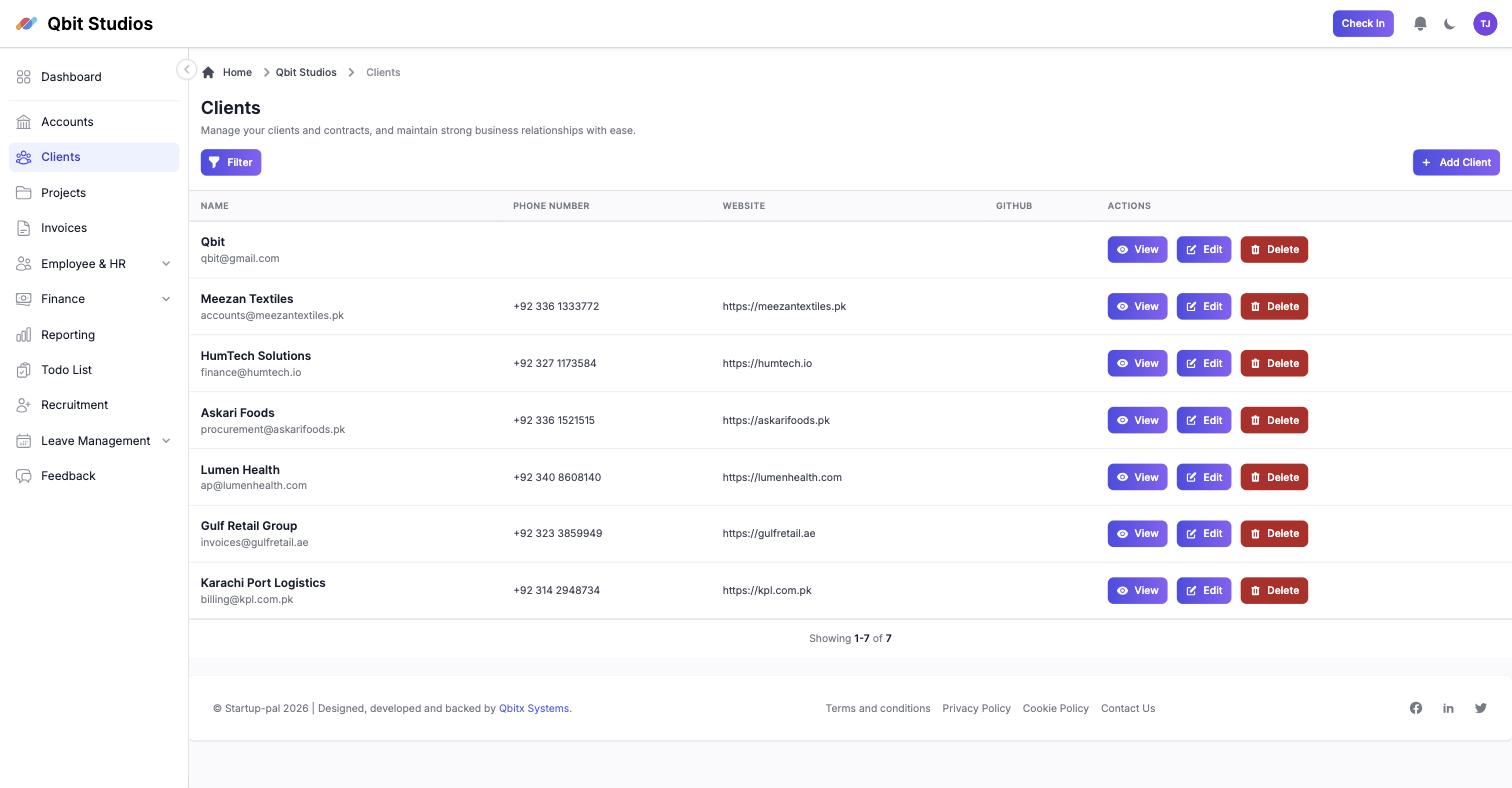
Projects & boards
Spin up the project and its board.
Budget, deadline, tasks, assignees. The board is where the work actually happens, and it already knows whose client it belongs to.
carries forward budget · deadline · assignees
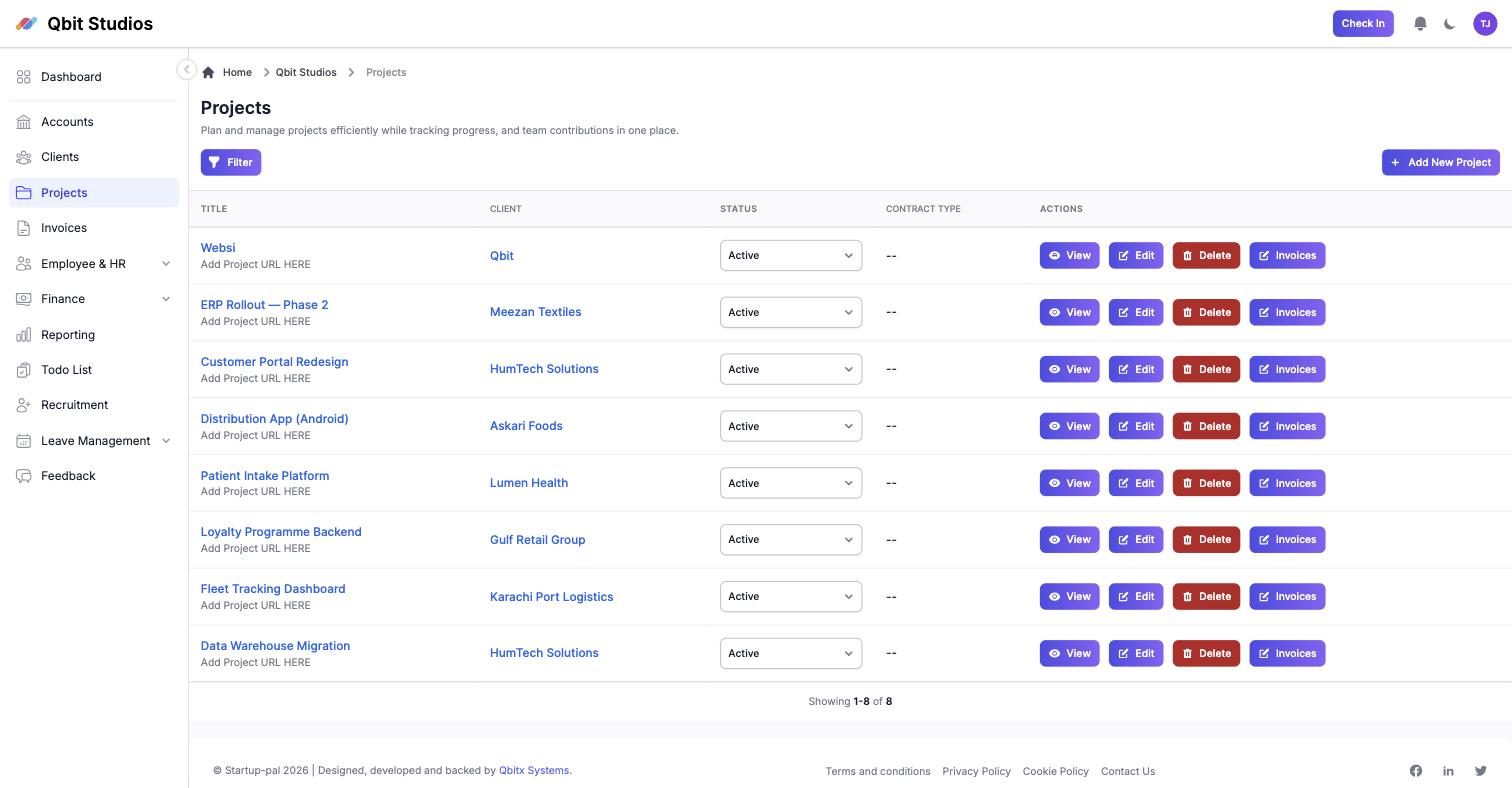
Attendance & timesheets
The team logs hours against real tasks.
Hours attach to the task, which belongs to the project, which belongs to the client. No separate time-tracking tool to reconcile at month end.
carries forward hours × rate
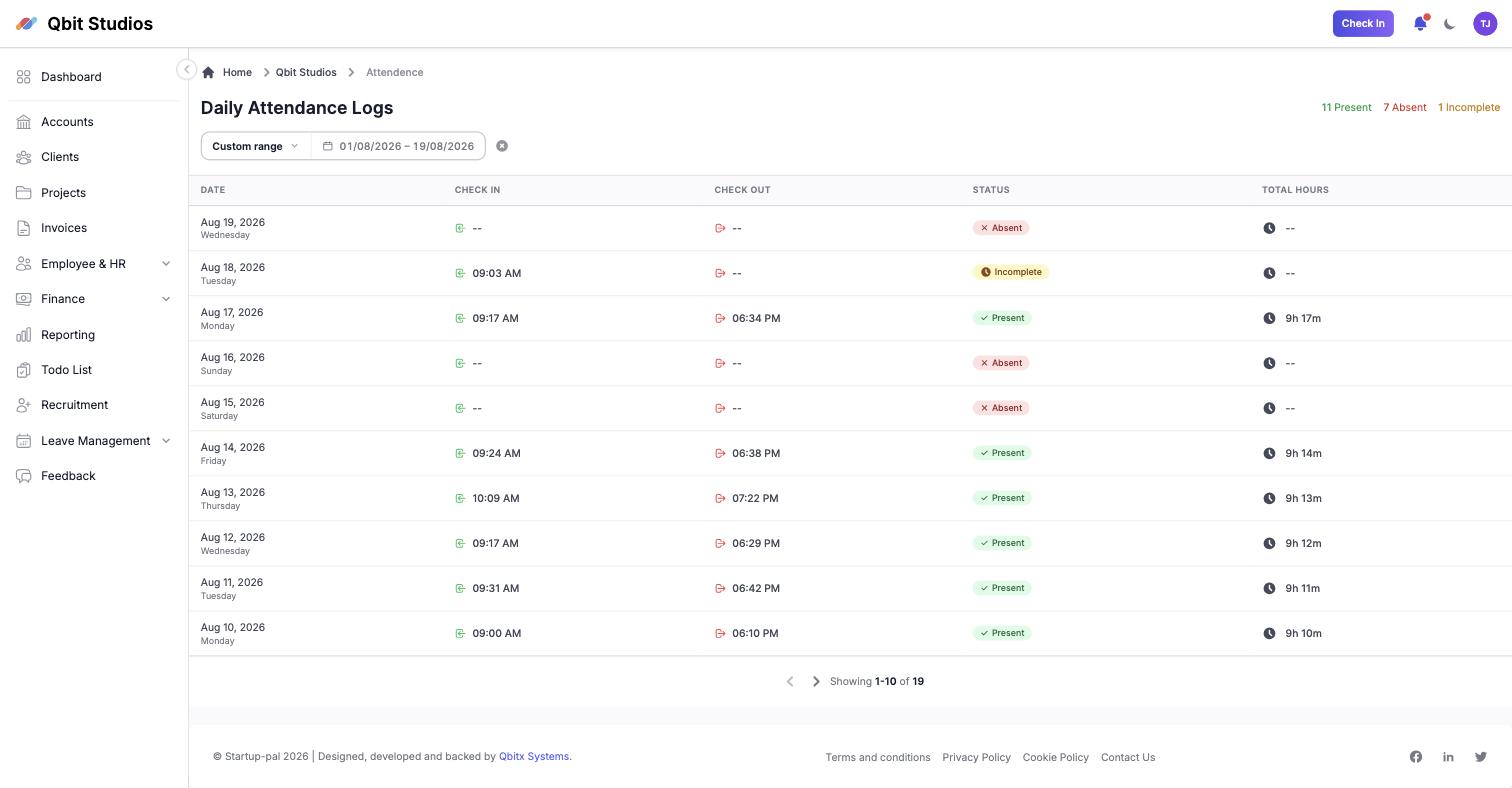
Invoicing
Those hours become invoice lines.
Generate a branded invoice from work already recorded. Nothing is re-keyed, so nothing is mis-keyed, and the client sees a document that looks like a real company sent it.
carries forward amount · due date
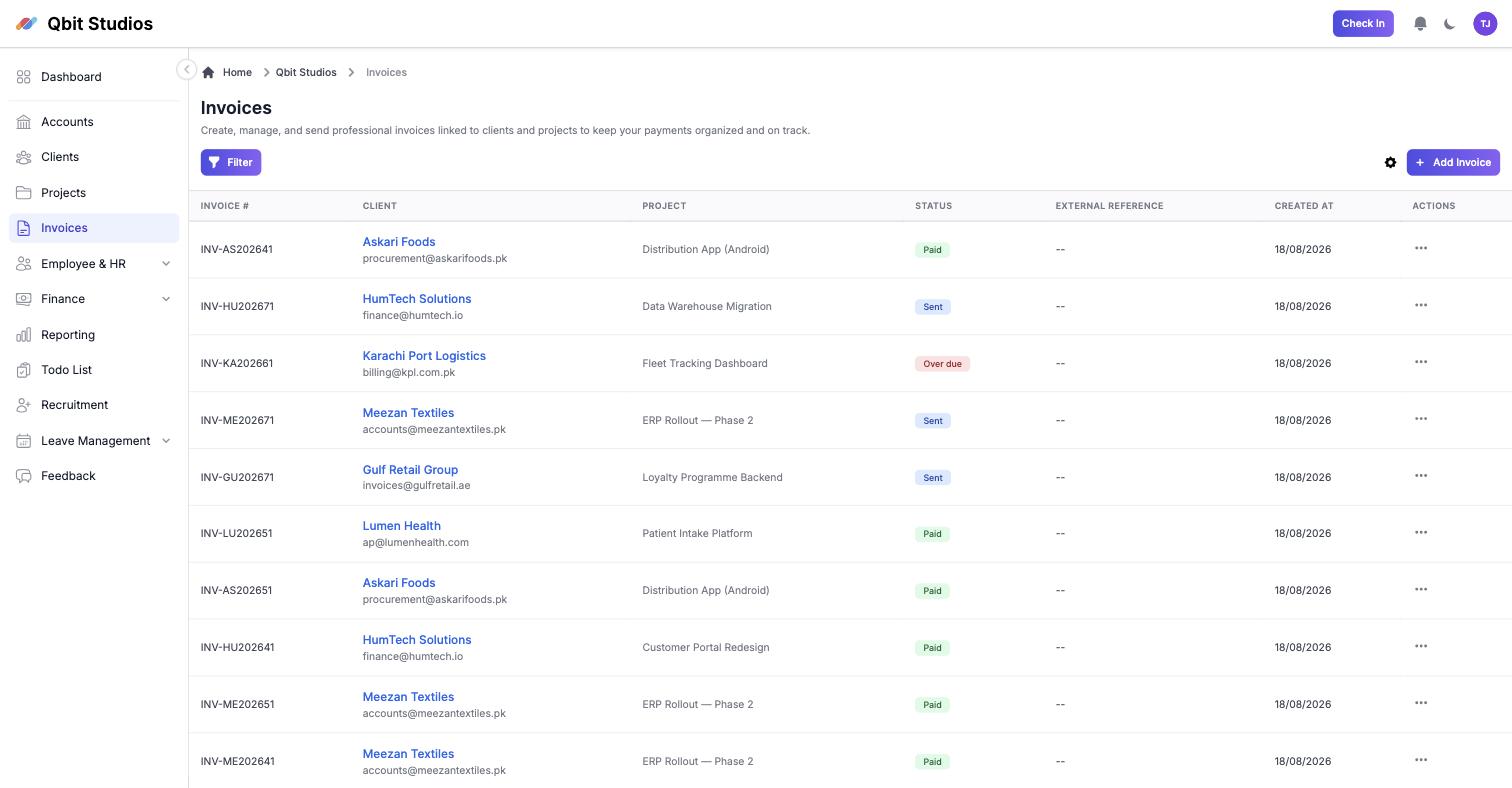
Payments
Record what actually landed.
Mark it paid, partially paid, or overdue. You can finally answer 'who owes us money' without opening a spreadsheet and hoping.
carries forward amount received · date
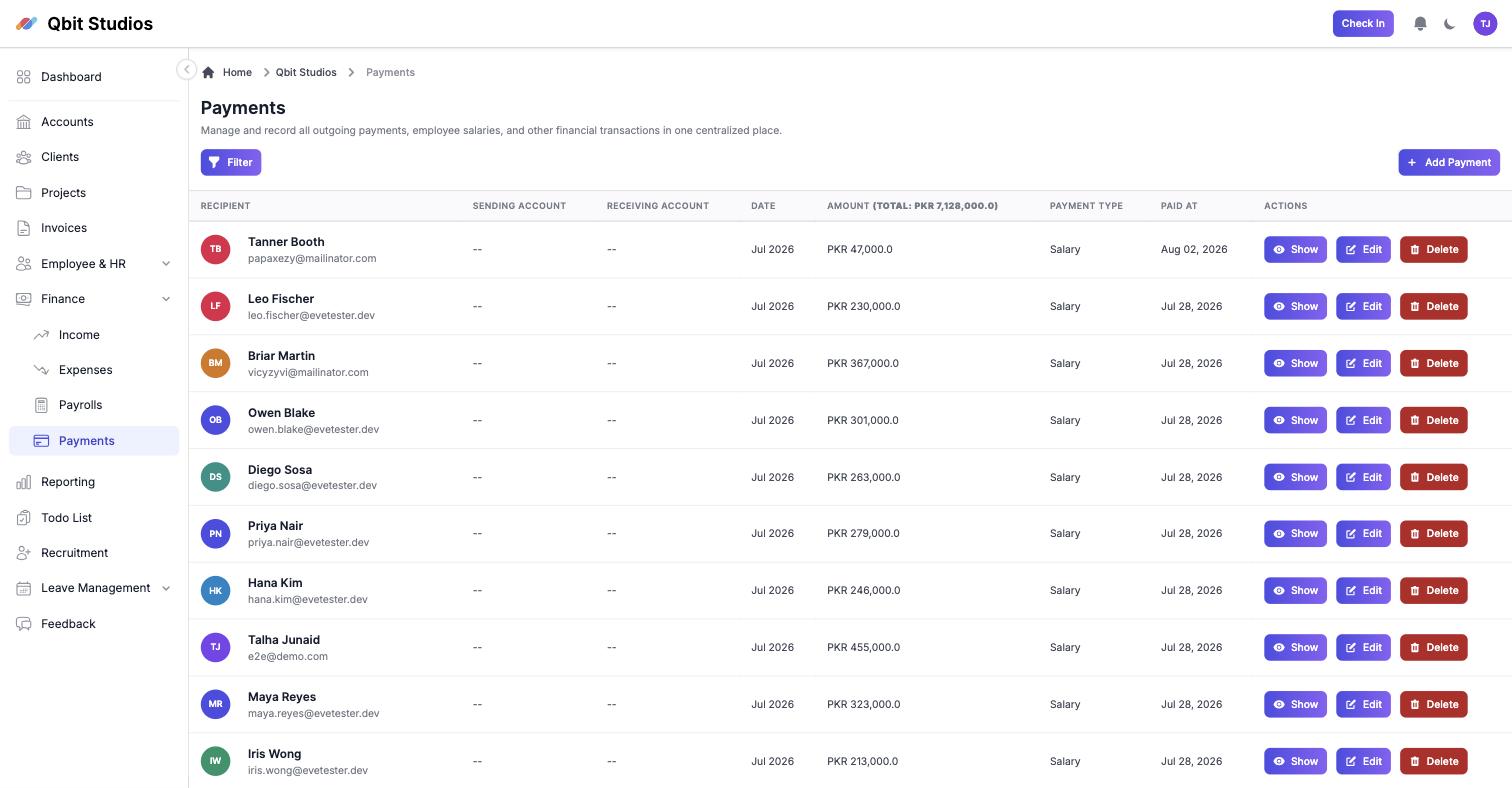
Finances
Revenue lands in your books.
Categorised, dated, attached to the client and project it came from. Your income statement builds itself as you work rather than in a panic each quarter.
carries forward categorised revenue
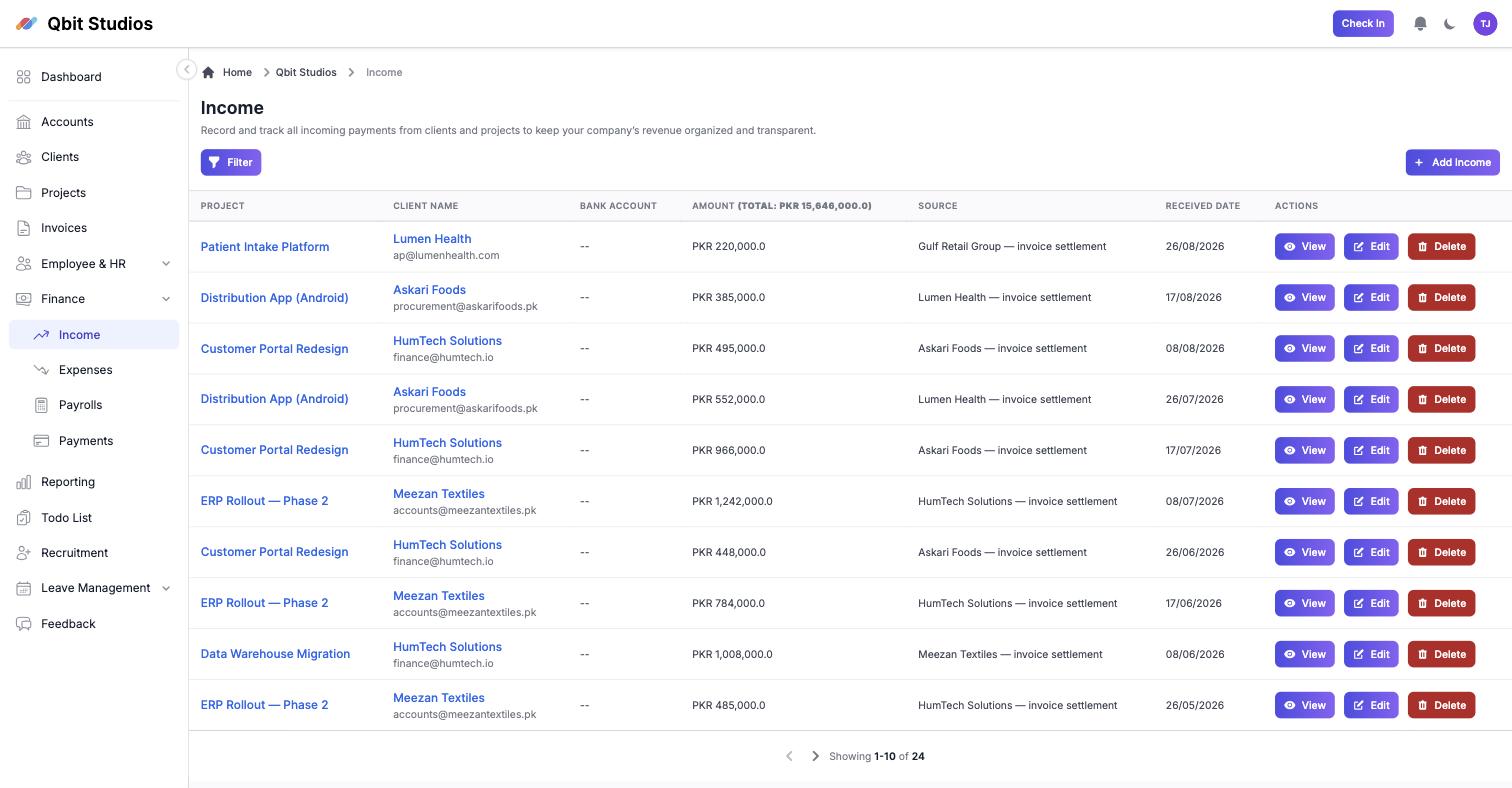
Payroll
Pay the team from the same numbers.
Salaries, allowances, deductions and provident fund — in PKR, on the 28th, in about twenty minutes. The people you pay are the same records that logged the hours.
carries forward salaries · deductions
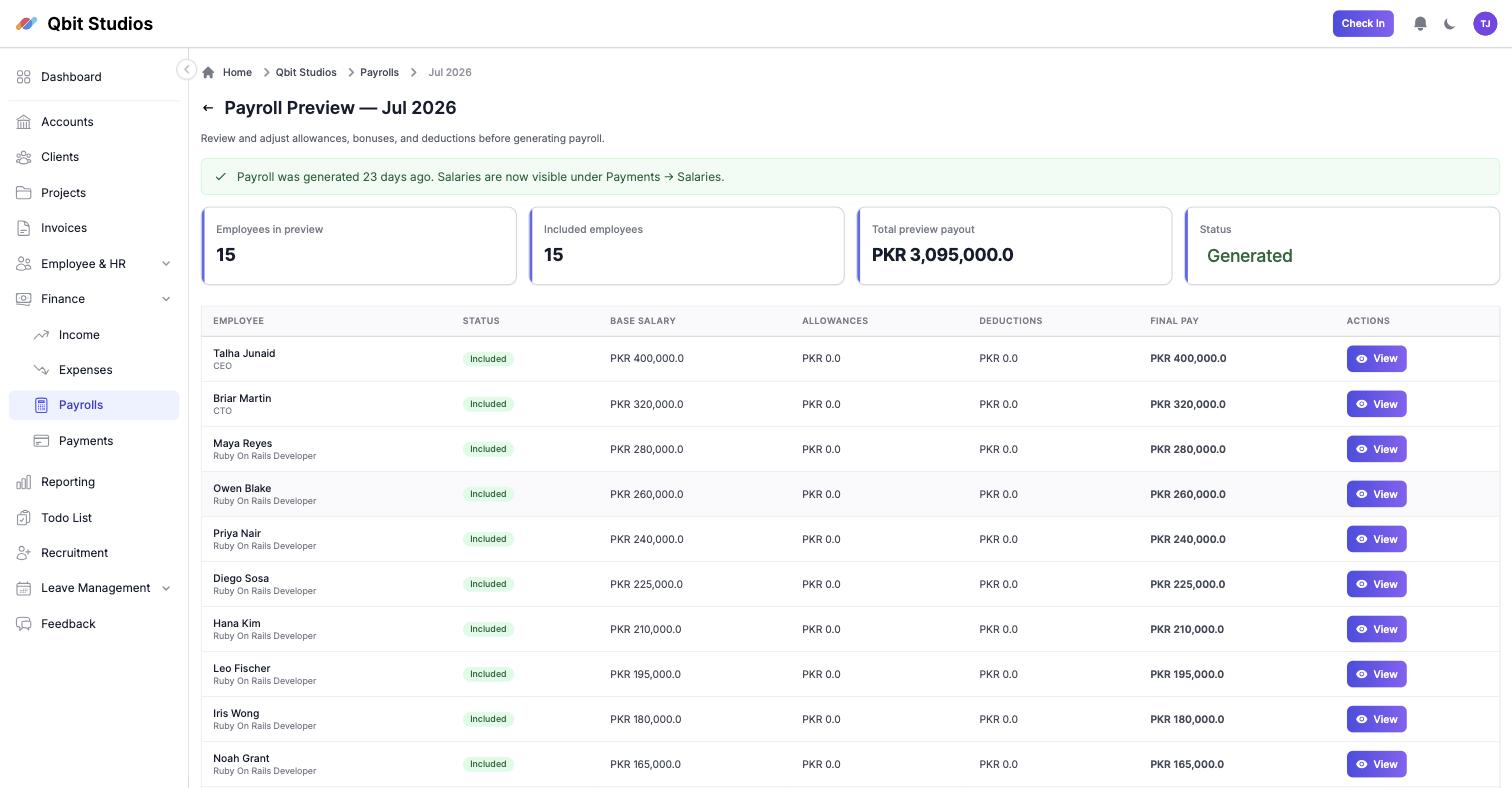
Reporting
Profit and tax reports build themselves.
Because every step above wrote to the same ledger, the year is already assembled when your accountant asks for it.
carries forward profit · tax position
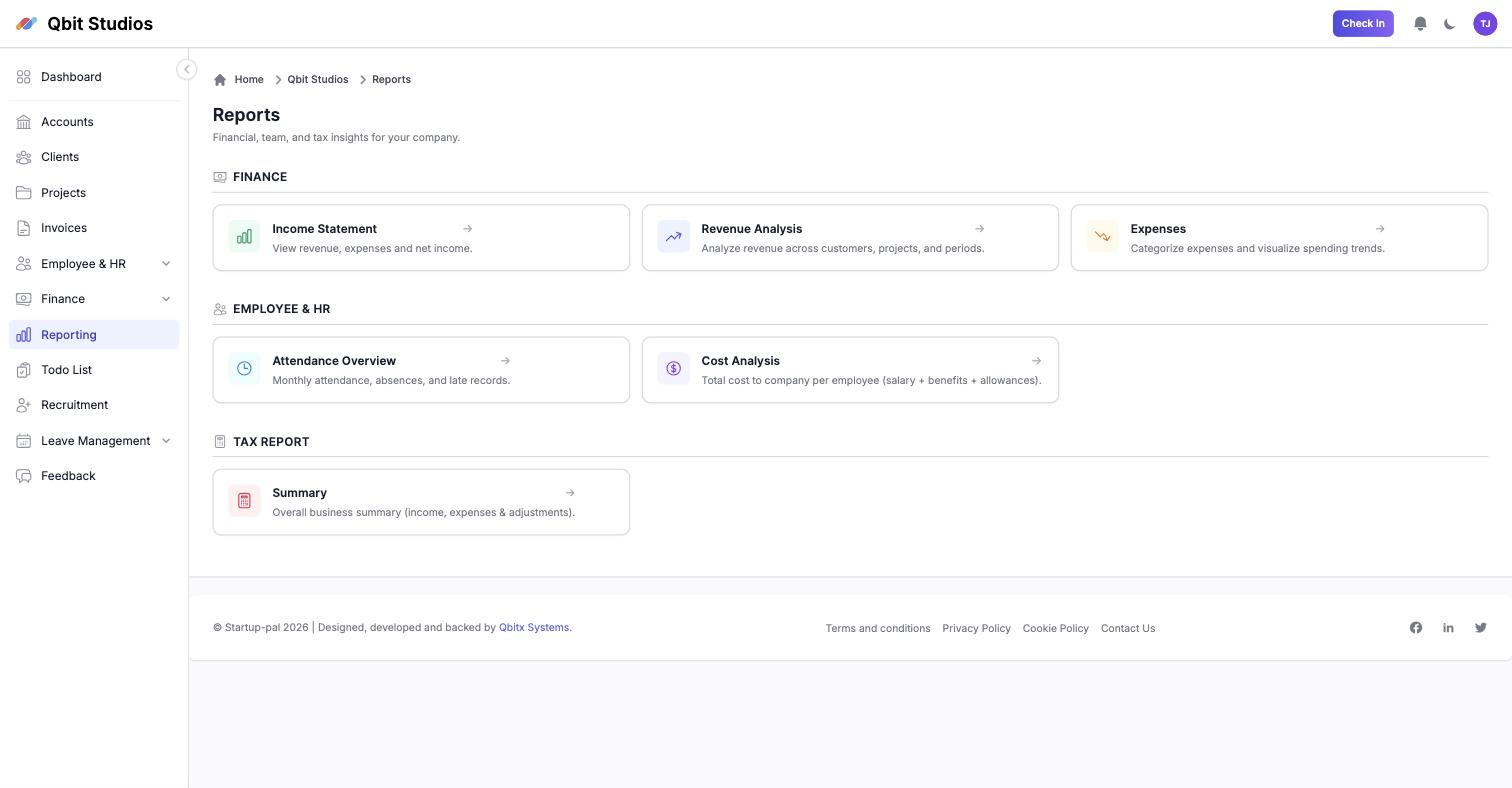
Everything in one login
Eight modules, one company — and an app for the people in it.
Projects & boards
Drag-and-drop boards, tasks, priorities and deadlines. Imports from ClickUp.
Invoicing
Branded invoices tied to projects, with paid and overdue tracked.
Finances
Income, expenses, categories, profit — and reports your accountant accepts.
Payroll
Monthly runs in PKR with allowances, deductions and payslips.
Attendance
Check-in with geofencing for field and remote staff. Timesheets included.
People & leave
Employee records, leave types, allotments, approvals and policies.
Hiring
Job openings, applicants, referrals and a pipeline board.
Reporting
Financial, team and tax reports built from everything above.
The 28th
Payroll is the part nobody else here gets right.
Foreign tools can build you a Kanban board. What they won't build is Pakistani payroll — provident fund, allowances, deductions, leave-adjusted salaries, all in rupees. So they don't, and you end up back in Excel on the 28th.
- Allowances and deductions per employee
- Provident fund and salary structures
- Leave and attendance feed the calculation
- Payslips generated for the whole team at once
- Every run recorded against the company's books
Twenty minutes, not two days. Because the hours, the leave and the people are already in the system that pays them.
The register book, replaced by the phone already in their pocket.
Your team gets their own app. They check in where they actually are, request leave without finding you, and read the policy instead of asking about it — and none of it arrives as a message you have to transcribe on Monday.
- Location-verified check-in and check-out
- Office QR for the people at the office
- Leave requests, types and running balance
- Company policies they can actually find
- Push notifications instead of chasing
- Scoped to them — never company finances
Included on every plan with employees on it. The hours they log land in timesheets and payroll without a second entry.
Today · Mon 28 Aug
Checked in
9:04 AM
Within the office boundary
Lala Zar Commercial, Lahore
Annual leave left
11 days
Check out
One button. If they can use WhatsApp, they can use this.
Where do you fit?
It scales down to one person and up to fifty.
Freelancers & solo
Clients, projects, time and invoices — without looking like a one-person operation.
PKR 900 /month
- Branded invoices in two minutes
- Know what's owed and what you earned
- Tax season already assembled
Hire someone later and payroll is already waiting.
Start freeSoftware houses & agencies
The whole operation, from the project you just won to the salaries you pay on the 28th.
PKR 4,500 /month
- Projects, boards and timesheets
- Invoicing tied to real logged work
- Payroll, leave and attendance
Most popular — up to 15 people, expandable.
Start freeLarger teams
More people, and usually a workflow of your own that the product should bend to rather than the other way round.
Talk to us
- Everything in the team plan, unlimited people
- Custom feature development
- 24/7 support and an account manager
Priced to your team and what you need built.
Talk to usWhat it costs
Fifteen people for PKR 4,500. After that, PKR 500 a head.
Almost everything else in this category charges per seat, in dollars — around PKR 3,360 a person once you convert it. That maths stops working very quickly at a Pakistani salary level, which is why most companies here are still on Excel.
- Startup-pal, this team
- PKR 4,500/mo
- Typical per-seat tool, same team
- PKR 50,400/mo
You'd keep PKR 45,900 every month. Per-seat pricing would cost you 11× more.
Our figure is PKR 4,500 for the first 15 people, then PKR 500 each. The comparison assumes $12/user/month, a common mid-tier rate, converted at PKR 280/USD — adjust it for whichever tool you're actually weighing us against.
What you get for it
- Unlimited projects and boards
- Unlimited invoices and clients
- Monthly payroll in PKR
- Attendance and timesheets
- Leave, policies and approvals
- Income, expenses and profit
- Hiring pipeline
- Financial and tax reports
No card needed. Solo? PKR 900/month.
Who's behind it
We built this to run our own company. We still do.
Startup-pal came out of Qbitx Systems, a software house in Lahore. Every month we run our own payroll on it, invoice our own clients with it, and approve our own leave in it. That is why the payroll module knows what a provident fund is — we needed it before you did.
If something here is wrong, it is wrong for us first.
Talha Junaid
Founder, Startup-pal · CEO, Qbitx Systems
“Payroll used to take the better part of two days and I still worried about it. Now it's a Tuesday morning job.”
“We stopped arguing about leave balances in December because nobody has to remember them any more.”
“I can answer 'what did we make last quarter' in about fifteen seconds. That used to be a phone call to the accountant.”
“Clients started paying faster once the invoices stopped looking like they came out of Word.”
Four slots, structured and ready. Fill them with real names, faces and numbers before this goes live — placeholder quotes are worse than an empty section.
The fair questions
You're about to put salary data in someone else's system.
Reasonable things to want answered first.
Where does our payroll data actually live?
Each company's data is isolated in its own tenant — nobody else's workspace can reach yours. Backups run nightly, and you can export everything you have put in, at any time, without asking us.
Read the security pageHow long does moving over take?
Import your employee list and client list from a spreadsheet and you are most of the way there. Boards import from ClickUp directly. We will sit with you on a call and do the first payroll run together.
See the migration guideWill my team actually use it?
Staff only touch three things: check in, request leave, log hours. All of it works on a phone. If your team can use WhatsApp, they can use this — and the parts they never need are simply not in their view.
See the employee viewWhat if we need help?
You message us on WhatsApp and a person who built the thing replies. We are in Lahore, on PKT, and we answer in Urdu or English.
Message us nowFrequently asked questions
Is there really a free trial?
Fourteen days, every plan, full access. No card, and nothing charges automatically at the end.
Does payroll handle Pakistani deductions?
Yes — allowances, deductions, provident fund and salary structures, calculated in PKR and adjusted for leave and attendance.
What happens to our data if we leave?
You export it. Everything you put in can come back out, and you do not need to ask us or wait for a support ticket.
Can we move our existing records over?
Employees and clients import from a spreadsheet, boards import from ClickUp, and we will do your first payroll run with you on a call.
Do you charge per user?
Not for the first fifteen — PKR 4,500 covers the whole company. Past that it is PKR 500 a person, against roughly PKR 3,360 for a typical $12 seat, so it stays a fraction of per-seat pricing as you grow.
Still unsure? Message us on WhatsApp — we usually reply within the hour, 9–6 PKT.
Make the 28th boring.
Fourteen days, the whole product, no card. If it hasn't saved you a day by the end of it, walk away.